Saturday, February 16, 2013

A Story Worth Telling

This week's culinary travels took us to Asia. Five students prepped a dish by sauteeing bok choy and kale, then cooking Japanese rice and barley on Tuesday afternoon.
 When they returned to the classroom, one student cook approached me to tell me the amount of salt the recipe called for the grains to be cooked in seemed high. I emailed Emilyinthekitchen and let her know, wondering if she'd need to cook up some unsalted grains to mix in before the dish was served at lunch on Wednesday. 

She stopped into class Wednesday morning, and explained to everyone that when she'd written out the recipe (which came from her brain and not a cookbook), she'd mistakenly written down the amount of salt. She'd  been thinking of how much she'd use if she was cooking more grain in a larger volume of water. Cooks make mistakes sometimes.

"So you'll have to throw it out?" someone asked with concern.
Not to worry, she reassured. Most of the time, cooks can fix their mistakes. As I predicted, the solution lay in adding more grains to the dish.

 While we were in the tech lab, researching continents, Emilyinthekitchen mixed the grains and sauteed vegetables together and got it heated up for lunchtime serving. The dish was a little on the salty side, but definitely tasty.

The feedback forms that came in were very positive. Some people (especially the younger kids) liked the saltiness of the dish, while others like the dish but suggested less salt next time. A few people really liked the kale prepared this way. In a school where an announcement of kale chips has been met with cheers, that's saying something!

Wednesday night, I got some wonderful feedback from a colleague. In an email, she wrote that two students, "were so excited to tell me about the barley dish today (which I LOVED by the way!) and so many kids said they really liked it. It's amazing what kids will eat when they are involved with learning about it and preparing it,"

She also said, "I had a conversation with [a student] who told me she didn't really like it because it was too salty. I told her how much I love salt and she kindly gave me a warning that salt can clog your arteries. I'm not sure that's really true, but the fact that she knew it wasn't healthy and wanted to pass along that health information was priceless."

I thought about all this as I started looking over the amazing pictures Anne took this week.


These kids are having fun while they're learning. And if you didn't know them, you would have no idea which ones have learning challenges,  and which ones are reading well above grade level. Some of my students have ADHD or their families are living in stressful conditions. But the pictures (in today's post and in the past), don't tell those stories. Cooking together has built our class community and leveled the playing field. It has allowed all of my students a chance to learn and have fun together. And that's a story worth telling.


Thursday, February 14, 2013

Valentine's Day

Valentine's Day: A chance to show your affection for people by plying them with chocolate. Wonderful and horrifying at the same time. As a chocolate lover, the only thing better is the day after Valentine's Day, when the chocolate all goes on sale. But as a teacher, Valentine's Day often turns into an excuse to encourage kids to overeat sugary treats in the name of celebrating.

Last year I took a stand and decided our class would observe Valentine's Day by making custom fruit smoothies while watching Cupcakes Wars. I started thinking aloud about this year while driving my children somewhere a couple of weeks ago.

"Maybe we'll make something not-quite-so-healthy," I mused.
"Let the kids have some fun and eat some sugar," said my sage almost-eleven-year old.
"Seriously!" chimed in the six year old.

I was seriously considering it. But the glitch is that our school has been trying to run a winter outdoor program on Thursday afternoons, which would eliminate the best chunk of time where we could cook something together. I knew I wouldn't be able to plan anything elaborate in the hopes that we were out of school this afternoon skiing and snowshoeing.  (The weather hasn't been cooperating, and on all but one week, the outdoor plans have been canceled.)  Then a parent contacted me asking if she could send in a special brownie treat in honor of the day. I decided to have our class celebration during morning snack in case the afternoon program ran. Kids would pass out all their valentines and indulge in brownies someone else made. Party plans complete.

But the opportunity to sneak in a vegetable experience landed in my lap, so what could I do?

My family gets a weekly share of vegetables from Pete's Greens. The owner, Pete Johnson, is a forward-thinking farmer who has figured out how to grow green vegetables in northern Vermont year round. Our share this winter has included greens almost every week, but at this time of the season most of it is stored root vegetables or frozen veggies. Yesterday, my husband brought home a bag filled with, among other things, Valentine radishes.

I stuffed a large one in my school bag and brought it to school as my Valentine's Day treat for the class.

We cut it open during morning meeting


and during snack, almost everyone tried a slice alongside their fudgy brownie and fruit from the kitchen. A slice cut in half looked enticingly like a wedge of watermelon!

The true victory was that no one freaked out about the idea of eating a weird bright pink radish on a day known for roses and candy. It was all just part of the fun.

Monday, February 11, 2013

Something to strive for

...and in news out of the UK: The government has accepted recommendations outlined in a School Food Plan, that will make sure every student in the UK will now be learning about food and healthy eating, with healthy cooking as part of the curriculum for all secondary students. 

Can you imagine this happening in the US? It's certainly something to strive for.

Saturday, February 9, 2013

Marvelous Muffins


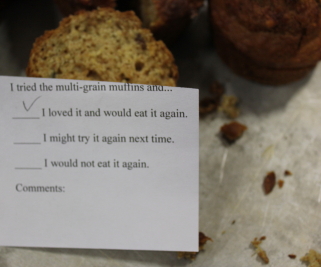
Not much to say, but lots to show. The Europe research group baked a gazillion muffins on Tuesday, using wheat, oats, and rye berries, plus other lovely ingredients like shredded apples and honey.


The whole school smelled spectacular after school and when I went to cover the cooled muffins at 3:45, I was tempted to sample one muffin. I reached deep inside myself, found some self control, and waited like everyone else until lunch on Wednesday.
One of the student bakers has a mentor and she came to lunch that day and helped serve alongside her mentee. It was nice to include an adult from the community in this adventure!

My only complaint about this process is that the research groups are baking and serving with other adults supervising them while I am working with the rest of the class. It's fantastic to have this coordinated support, but I feel like I'm missing a lot of the fun!


 Thanks again to parent and photographer extraordinnaire: Anne. Didn't she get some excellent shots?


Sunday, February 3, 2013

Sharing Our Learning

Silly me, I should have posted this days ago. It must have fallen off my radar because the cooking didn't happen in the classroom.

The World Geography unit is happening in collaboration with a Farm To School grant. Students all picked a continent to research and each week, starting last week, one group is cooking a dish that uses an indigenous grain and represents the cuisine from some part of the continent. The next day, they will share a bit about their dish in our weekly whole school meeting and then serve the dish at lunchtime.

Last week the South America group began the process. They left class for an hour and a half to work in the kitchen preparing a Peruvian Quinoa and Amaranth Salad. Anne, a talented parent  (also generous with her time) came in to document the process. All the pictures in this post are courtesy of her.


A good cook always checks the final product!

The next day they presented it to the school and served at lunchtime.

sampling cups are an option to try a little bit
Don't you want to eat at my school? There's an enchilada underneath all that salsa.
Toward the end of lunchtime, they went around collecting feedback about the dish. Would you eat it again? Definitely, maybe or definitely not?


Later, in class, they sorted through the feedback, with an eye toward sharing it with the kitchen staff. That work isn't done yet, but I was fascinated listening to them trying to figure out which math skills they needed to apply.

"We need to find the mean."
"No, we don't."
Finally they ask me what I thought and I suggested turning the responses into fractions.
"Percentages!" one sixth grader exclaimed.
Calculators came out and debates began about how to do this. (Sixth graders will soon be learning how to convert fractions to percentages, but haven't started this yet.)
When it was time to clean up, I had to ask them to stop several times before they did.  I just love it when kids get into math like this!

This coming week: the Europe group makes a multi-grain muffin...

Saturday, January 26, 2013

World Grains

My students are now expert at world grains. And hopefully our "travels" have also given some much needed review of the continents.

This week we cooked rye berries while reading a short article that hinted that rye was primarily farmed in Europe without actually saying so. A perfect opportunity to practice the reading skill of inferring!

I cracked up when kids described the cooked rye as looking like maggots. One student took a leap of faith, tried the cooked berries, and then exclaimed, "It tastes like insects crawling around in my mouth!" Needless to say, he did not finish his serving! Personally, I thought that they tasted like a more savory version of wheat berries, but I like that pop-and-smush texture under my teeth.
Exploring an uncooked grain
We also made polenta out of cornmeal, which made me feel Fagan-like again when serving the thin gruel. After a short discussion I convinced most everyone that people generally don't dry corn kernels and then cook the whole kernel after it's been dried, so it was okay for us to use cornmeal as a starting point.


This week's highlight, for me at least, was cooking t'eff, a tiny brown African grain. When kids saw the cooked product, many exclaimed, "It looks like brown amaranth!" I love that their horizons' have expanded so much that they are using a somewhat obscure grain like amaranth as a reference point for the newest weird grain.

T'eff was very popular with some but less appreciated overall. Considering its price and how difficult it is to access, it is also the least likely grain to eat on a regular basis. (I ordered a pound of it from an Amazon seller for a whopping $10.85, whereas every other grain was available locally.)

This week I've also been modeling the research process with a familiar continent: North America. Next week everyone will start researching a continent of choice, learning about its geography, climate, native peoples, immigrants, and staple foods. We'll put all our learning together on a website, which will be a new technological accomplishment for me.

Class display with a small bag of a representative grain connected to each continent, expanded below


Saturday, January 19, 2013

Back in the Saddle


Have you wondered what's been going on in my classroom? Until this past week, we took a short break from cooking to get back into the school routine after vacation and to give us time to do non-food focussed science experiments.

But I was thinking about cooking, making plans...

Our winter social studies unit is World Geography and we are using food, specifically grains, as an entry point to the topic. This past week I started off with a pre-test to make sure everyone knew their continents. Ruh-roh! Most kids clearly needed a refresher, so my plans to introduce one grain for every continent was a perfect activity on multiple levels.

We started with a Match The Grains activity that I didn't invent, but did adapt to the grains that we've identified as being indigenous to each continent. Did I say "we"? That would mean me, Emilyinthekitchen, and Kristen, an employee of the district food cooperative whose focus is on food education. We have grant funds supporting this unit and spent half a day in December cooking up plans for this unit.


The Match The Grain activity got kids looking at ziplog bags full of nine different grains, and then trying to figure out which typed description went with each baggie and what the name of the grain was. We had regular stuff, like brown rice, barley and quinoa (because barley and quinoa is "regular stuff" in our amazing hot lunch program). But we also had weirder stuff like rye berries, amaranth, and millet. Kids got into the exploration and it felt like a great kick off to the unit.

For the next three days we cooked up one grain per day and ate it at snack. At the same time, kids examined the uncooked grain up close and personal (meaning they got to touch and sniff it) and recorded the grain, the continent of origin and labelled the continent on a map. I've posted this information on the bulletin board as well.
Cuplets of amaranth, ready to be poked and prodded
On their personal charts kids are also writing down descriptors for each grain before and during cooking, as well as descriptors from eating it. Almost everyone's tried every grain, most kids liked them all, and many kids wanted seconds! Each grain has been cooked in salted water and served with a bit of butter, but we've also talked about how else they'd like to season each grain or what they'd recommend serving it with. They are all budding chefs...

Amaranth: gritty but tasty

As I served kids globs of barley on Thursday at snack, I heard an imaginary voice in my ear say,
"Please miss, can I have some more?"

Of course, not everything's gone perfectly. For instance:
- My children have been sick and I had to keep adapting plans each day as Plan A became Plan B became Plan C. There's only so much you can ask a substitute to do...
- I've been less than scientific about how much salt and butter has been dumped into the pot each day, so it's possible that barley got rave reviews because of the supporting role butter played.
- The display board is serving its purpose, but looks a little bit like a third grader put it together, no disrespected to third graders intended. This is because of staffing changes I no longer have the support of the fabulous Barb. This was the first bulletin board display I put together myself in over a decade, and it showed.

None of this is critically important, though. Kids are eating new grains, making connections with the continents, and hopefully getting interested in all that is to come. We'll finish the grain tour de continents at the beginning of next week and move on to the next phase of the unit.

I'll leave you with an opportunity to test your own grain knowledge. Do you know which grain originated on which continent? (For the purposed of this unit, originated can also mean cultivated, even if it originally grew wild elsewhere. Because if you look far enough back, almost everything came from Asia.)

amaranth                          quinoa
corn                                  rye
millet                               rice
oats                                  teff
wheat                               barley

Have fun!